
“If we don’t end war, war will end us.”—H. G. Wells
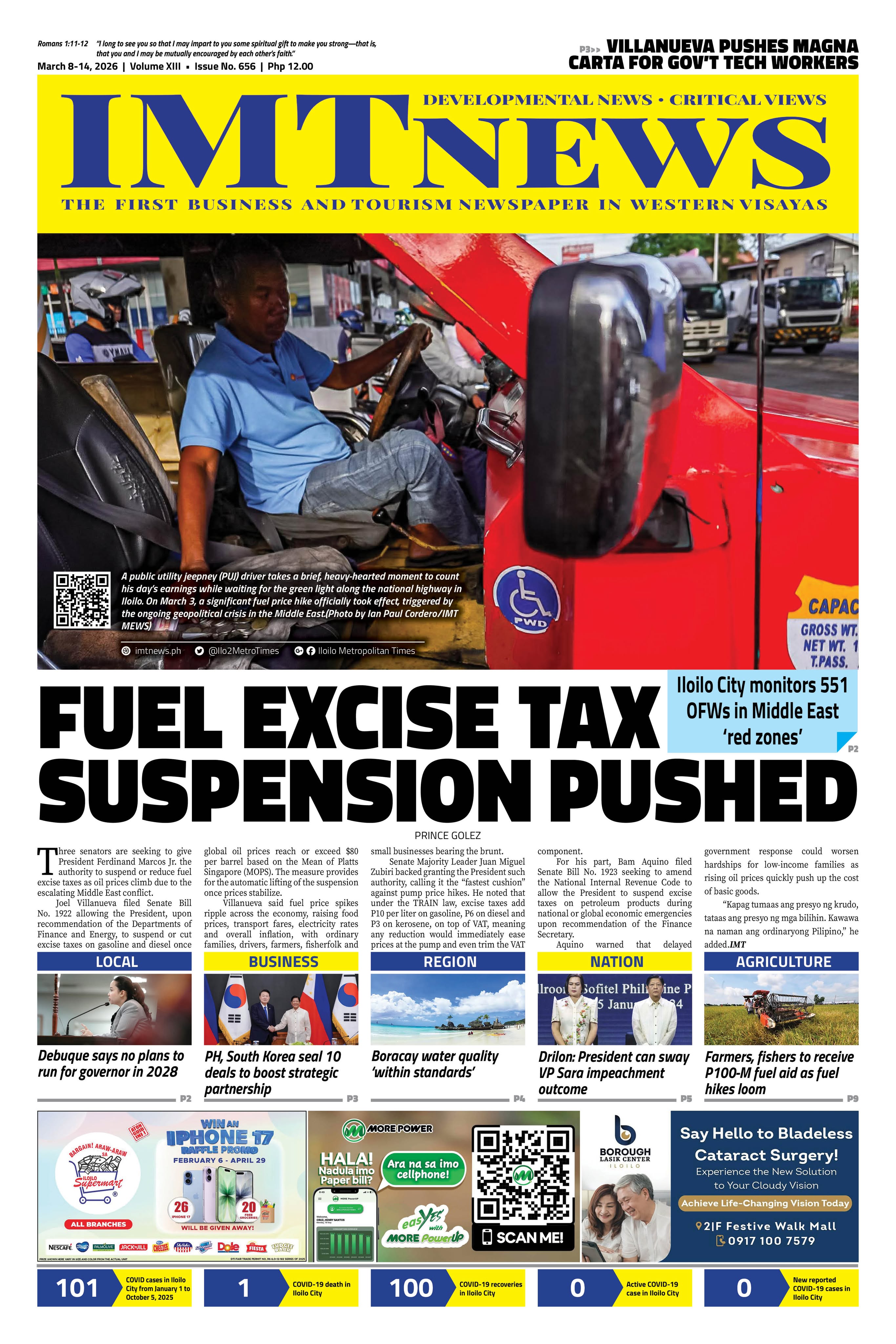
THE real crisis Filipinos face today is not the squabble of politicians, but inflation triggered by oil price hikes following the recent missile attacks in the Middle East.
It is not the number of suitcases or baggages containing allegedly billions of pesos distributed by the 18 ex-marines to politicians allied to President Ferdinand “Bongbong” Marcos Jr. and his family.
Not whether Vice President Sara Duterte-Carpio will be convicted in the impeachment trial, but the rise in the costs of transportation, electricity, and basic commodity.
Once the Filipinos bellyache, it’s not only crisis, it’s hell.
Surges like the predicted P20/liter diesel increase instantly tighten household budgets, increase business operational costs, and pressure the peso based on the fact that the Philippines imports 90 percent of its oil.
Transport fares, logistics expenses, and electricity rates, which in turn drive up the prices of food and consumer goods, are sure to increase directly because of rising fuel costs.
Households, particularly low-income groups, face reduced purchasing power. Public utility vehicle (PUV) drivers and fishermen are heavily affected, often forced to seek alternative income sources.
A sustained $10 increase in crude prices adds roughly P55 to P60 billion to the country’s annual import bill, weakening the Philippine peso which was breaching the $1 to P60 mark.
-o0o-
Here in the United States, gas prices have also surged as the fallout from the U.S.-Israeli attack on Iran continues to choke global oil supplies.
As of March 7, data from the AAA motor club showed the national average for a gallon of regular gasoline jumped by 14 percent in a week to $3.4.
The price was under $3 a week ago, but the conflict has severely disrupted oil flows through the Strait of Hormuz, sending crude oil above $90 a barrel. Natural gas prices in Europe have risen even more sharply, according to Time editor Richard Hall.
“The last time the national average made a similar weekly jump was back in March of 2022 during the start of the Russia/Ukraine conflict,” the AAA said.
Gas prices are expected to rise even higher. AAA noted the last time crude oil was that high, the average price of a gallon of gas in the U.S. was $3.80.
The Strait of Hormuz, a vital waterway off the coast of Iran through which about 20 percent of the world’s crude oil and natural gas typically passes, has officially closed as a result of the worsening U.S.-Israel vs Iran war.
-o0o-
A Revolutionary Guard spokesman said on March 7 it would remain open to all traffic except U.S. and Israeli ships as the badly bruised Iran threatened to hit any vessel from traveling through in the first days of the conflict.
“We did not close the Strait of Hormuz and will not, but we will target ships belonging to the U.S. regime and the Zionist entity transiting the Strait of Hormuz,” a spokesman said, according to the Wall Street Journal.
Reuters reported the number of tankers passing through the strait has nevertheless dropped to zero since Wednesday.
Retaliatory Iranian missile attacks on oil and gas infrastructure in Gulf countries that host U.S. military bases, such as Saudi Arabia, Qatar and the United Arab Emirates, have also impacted the production and prices, according to Hall
President Donald Trump made affordability a central plank of his 2024 campaign for the White House, and in his State of the Union address late last month, he boasted about his Administration’s ability to keep them down.
“Gasoline, which reached a peak of over $6 a gallon in some states under my predecessor and was, quite honestly, a disaster, is now below $2.30 a gallon in most states, and in some places $1.99 a gallon,” the president claimed. “And when I visited the great state of Iowa just a few weeks ago, I even saw $1.85 a gallon for gasoline, the lowest in four years, and falling fast.”
-o0o-
THE USE OF HAVING TWO EYES. If we look at our room with one eye only, we will find that it looks much flatter than it does with two eyes. With two eyes we can see that the chair is n front of the desk, that the wastebasket is round and that the closet looks deep. Our eyes are set from about two to two and a half inches from each other–measuring from center to center.
KNOWLEDGE IS POWER. We hear better on water than on sand. Sound is composed of waves that pass through the air. These waves are broken up and interrupted when they strike against solid obstacles. On land, sound-waves usually can not travel very far without striking against houses, or trees, or mountains or some other objects that stand in their path.
KNOWLEDGE IS POWER. Does sound go on forever? No sound lasts forever as a sound. The waves that carry the sound become weaker and weaker, and finally our human ears can hear them no longer. Nor is there any scientific instrument, no matter how delicate, that can record sounds after a certain length of time as passed.
Alex P. Vidal, who is now based in New York City, used to be the editor-in-chief of two leading daily newspapers in Iloilo, Philippines.—Ed