There is a peculiar routine that comes with a brownout in Iloilo. The electric fan stops. The Wi-Fi disappears. Someone checks the utility advisory while another looks outside to see whether the neighbors have also gone dark. Phones become flashlights, rechargeable lamps emerge from drawers, and people begin calculating how long the refrigerator can stay cold. We have become surprisingly good at adjusting to unreliable electricity. Perhaps that is precisely the problem.
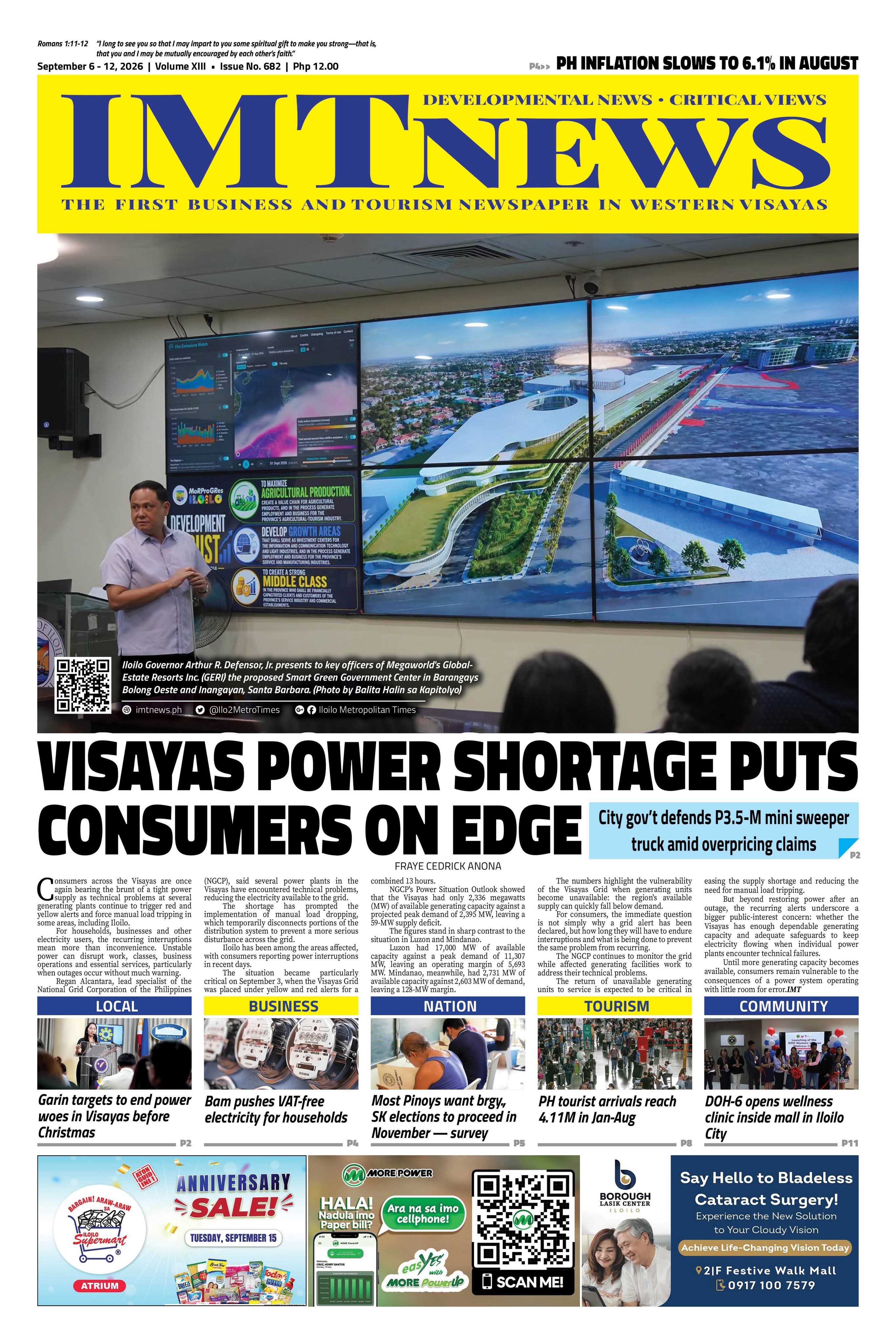
The latest rotational brownouts are not simply an Iloilo problem. They are symptoms of a Visayas grid running dangerously short of dependable supply and reserves. On September 8, the grid went under red alert again as available capacity fell below what was needed for demand and regulating requirements. Major generating units remained unavailable, while imports from Mindanao were limited. This is why blaming the distribution utility like ILECO or MORE Power whenever the lights disappear may be emotionally satisfying but technically incomplete. A distributor cannot deliver electricity that is unavailable upstream.
The numbers are harder to excuse. From January 1 to September 7, the Visayas grid accumulated 96 yellow alerts and 33 red alerts. Energy Secretary Sharon Garin herself called the situation “unacceptable” and said the government was treating it with urgency. Several generating units are expected to return this month, Panay Energy Development Corporation Unit 3 is targeted for October 3, and 253 megawatts of battery storage are being lined up across the Visayas. Those are welcome interventions. But 129 grid alerts in barely eight months suggest something more troubling than a bad week at the power plant.
For Ilonggos, there is an irony here that is difficult to miss. The Energy Secretary now dealing with the brownouts is one of our own. Sec. Garin studied accounting at UP Iloilo, served the province in Congress, and now finds herself confronting an energy crisis hitting her home region particularly hard. That should not make her personally responsible for every tripped generator or delayed project. Energy systems are too complicated for such convenient blame. But familiarity with the region also means she knows, perhaps better than most in Manila, what these outages cost communities far from the capital.
And the cost is not measured only in megawatts. A sari-sari store worries about ice cream melting in the freezer. A student loses internet halfway through an assignment. A small restaurant loses customers during dinner. A home-based worker misses an online meeting. Families endure humid nights, businesses burn diesel, and equipment becomes vulnerable to unstable supply. Those with generators, batteries, and solar systems buy themselves resilience. Those without money simply wait. Brownouts may be technically indiscriminate, but their consequences are not. Earlier outages in Western Visayas already showed how small enterprises and ordinary households absorb the disruption more directly than establishments able to afford backup power.
That is why “fix it first, blame later” is both sensible and insufficient. Of course, the grid must be stabilized before officials conduct a public autopsy. Nobody wants an investigation instead of electricity. But accountability cannot remain permanently scheduled for later. When a region records dozens of alerts, consumers are entitled to ask whether adequate reserves were procured, why generating units remained unavailable, which investments were delayed, and whether earlier warnings produced enough action.
Lawmakers are now asking similar questions. A congressional inquiry has been sought into recurring outages and the cost and actual delivery of ancillary services—the reserves consumers already pay for. The inquiry seeks to determine how much was collected, who received the payments, how much reserve capacity was actually available, and whether refunds or penalties may be warranted when contracted reserves were not delivered. That is not finger-pointing for sport. It is a reasonable question about what consumers received for money already taken from their bills.
The frustration also comes from a nagging sense of déjà vu. Western Visayas went dark before, most seriously in 2023, when weaknesses across the power system became painfully clear. The lights eventually returned, but apparently some of the lessons did not stay on. A reliable grid is not one that works when every plant behaves perfectly. Reliability is what remains when something goes wrong.
Government cannot prevent every turbine failure, transmission problem, or unexpected surge in demand. Neither can Secretary Garin personally switch a failed generating unit back on. Fair criticism begins there. But governance is partly the work of anticipating failure: ensuring reserves exist, infrastructure keeps pace, rules encourage reliability, agencies coordinate, and someone answers when the same vulnerabilities repeatedly leave millions of people in the dark.
The promised returning plants and battery systems may ease the immediate shortage. I hope they do. But the harder test comes after the red alerts disappear from the news. Will the Visayas emerge with enough redundancy and dependable capacity that the next failed plant becomes an inconvenience rather than another regional crisis?
For now, Ilonggos will keep doing what we have learned to do: charge the power bank, save the document, check the advisory, and wait for the electric fan to turn again. The lights eventually come back. The more unsettling question is why, after all these years and all these warnings, we still have to wonder when they will go out again.
Doc H fondly describes himself as a ”student of and for life” who, like many others, aspires to a life-giving and why-driven world grounded in social justice and the pursuit of happiness. His views do not necessarily reflect those of the institutions he is employed or connected with.
Brownouts, excuses, and accountability