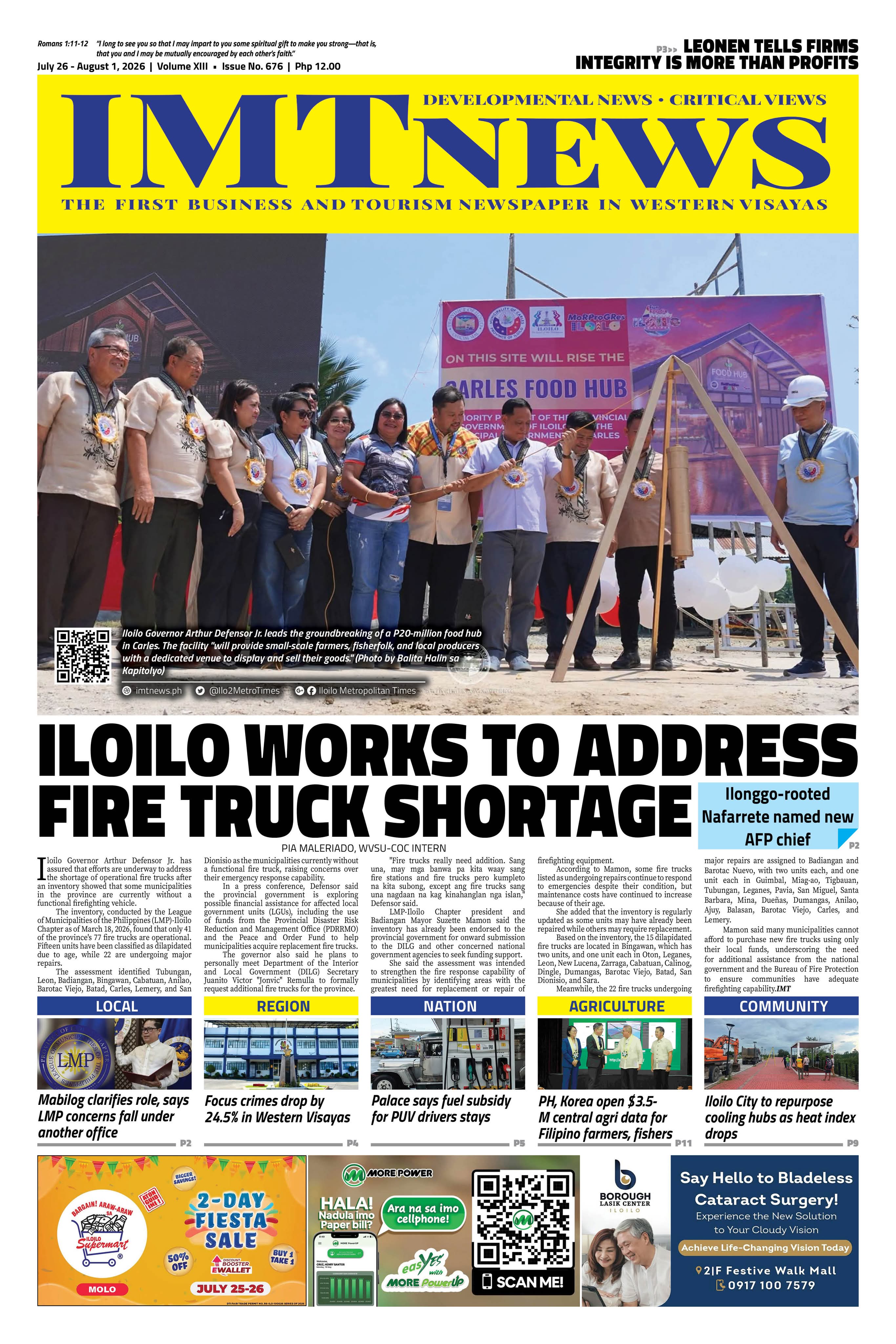

There is something unsettling about seeing a fire truck parked in front of a station and realizing it may never leave the garage when the alarm sounds. The fire station is there. The firefighters are ready. The emergency hotline works.
The problem is that, in some municipalities in Iloilo, the fire truck may not be.
That is the uncomfortable reality revealed by the latest inventory of the League of Municipalities of the Philippines (LMP)-Iloilo Chapter. Out of 77 fire trucks across the province, only 41 are operational. Fifteen are already considered dilapidated, while 22 are undergoing major repairs. Eleven municipalities—Tubungan, Leon, Badiangan, Bingawan, Cabatuan, Anilao, Barotac Viejo, Batad, Carles, Lemery, and San Dionisio—have no functional firefighting vehicle.
If that sounds alarming, it should.
A fire does not politely wait until procurement is completed, a budget is approved, or a replacement unit arrives. Flames do not ask whether an LGU is financially capable of buying a new truck. They simply burn.
Governor Arthur Defensor Jr. deserves credit for acknowledging the problem instead of pretending it does not exist. He has committed to explore provincial funding through the Provincial Disaster Risk Reduction and Management Office and the Peace and Order Fund. More importantly, he plans to seek additional assistance from the Department of the Interior and Local Government (DILG).
That is the correct response. But it also raises a harder question.
Why did it take an inventory to confirm what every firefighter who has struggled with an aging truck already knew?
Maintenance is one of government’s least glamorous responsibilities. It rarely earns ribbon-cuttings, photo opportunities, or social media applause. Yet it is maintenance—not ceremonies—that keeps a fire truck running when someone’s home is on fire.
The irony is difficult to ignore. We proudly inaugurate new buildings and celebrate infrastructure milestones, but the equipment that protects those very investments quietly grows old in the garage.
The numbers tell the story. Nearly half of Iloilo’s firefighting fleet is either beyond its service life or unavailable because it is being repaired. Some trucks classified as “under repair” are reportedly still responding to emergencies. That is less a sign of resilience than of necessity. It reflects the dedication of firefighters who continue to serve despite aging equipment, but it also reveals how dangerously close the system has come to relying on hope instead of preparedness.
The shortage also presents an early test for the DILG’s public safety leadership.
When he assumed office as DILG Undersecretary for Public Safety, Jed Patrick Mabilog pledged to strengthen public safety systems, promote integrity and accountability, and support responsive governance. Those are welcome commitments. But public safety is measured less by speeches than by the readiness of emergency responders on the ground.
There is perhaps no more practical measure of that readiness than a fire truck that starts when the alarm sounds.
For Iloilo, this issue is also personal. One of its own now helps oversee public safety at the national level. That presents not merely an opportunity for hometown pride but a chance to translate national policy into local action. If there is a province that should demonstrate how national and local governments can work together to improve emergency preparedness, Iloilo has every reason to lead by example.
This should not become another story that briefly captures attention before disappearing into a pile of pending requests. Every year, communities conduct Fire Prevention Month activities. Schools hold evacuation drills. Offices rehearse emergency procedures. Yet preparedness begins long before the drill. It begins with equipment that works.
A fire station without a functioning fire truck is like a hospital without an ambulance. It looks complete until someone desperately needs it.
The inventory prepared by the LMP-Iloilo Chapter should not simply be filed away as another government report. It should become the basis for a long-term replacement program for firefighting equipment, with predictable funding, regular maintenance schedules, and clear accountability for keeping emergency vehicles operational.
Because when the next fire breaks out, no family will ask whether the truck was funded by the province, the DILG, or the Bureau of Fire Protection.
They will ask only one question:
“Where is the fire truck?”
And in some towns in Iloilo today, that question may not have an answer anyone wants to hear.